- Perfect communications solution for small and medium-size businesses:
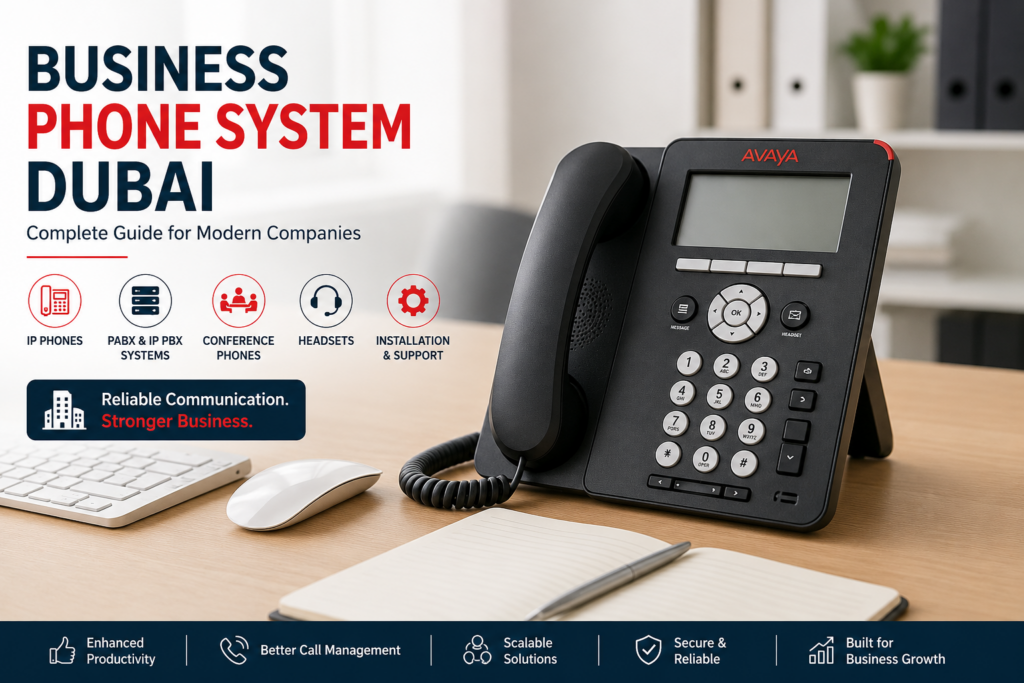
Choosing the right business phone system in Dubai is an important decision for companies that depend on reliable communication with customers, suppliers, employees and business partners. Whether you operate a small office, large enterprise, call center, hotel, healthcare organization, educational institution or multi-branch company, your telephone infrastructure can directly affect how efficiently your employees communicate.
A modern business phone system is no longer simply a collection of desk phones. Today’s business communication environment can include IP phones, PABX systems, IP PBX platforms, VoIP connectivity, conference phones, business headsets, call management features and professional installation and support.
For companies searching for a business phone system Dubai solution, the first step is understanding which technology and equipment best match the organization’s users, network infrastructure, calling requirements and future growth.
This guide explains what businesses should consider when selecting an office phone system in Dubai and how different communication components can work together to create a reliable business communication environment.
A business phone system is a communication platform designed to manage telephone calls within an organization and between the organization and external callers.
Unlike a basic residential telephone setup, a business telephone system can support multiple extensions, departments, users, incoming calls and outgoing calls. Depending on the technology selected, businesses may also have access to features such as call transfer, call forwarding, voicemail, auto attendants, conference calling, extension dialing and centralized call management.
Modern systems can use IP-based network connectivity, allowing voice communication to operate over an organization’s network infrastructure.
A business phone system can therefore include several components:
The right combination depends on the size and communication requirements of each business.
Dubai has a highly competitive business environment, with organizations ranging from small startups to multinational enterprises operating across many industries.
For these businesses, communication needs to be professional, dependable and easy to manage.
A customer calling a company should be able to reach the appropriate department without unnecessary delays. Employees should be able to transfer calls efficiently. Managers may need to communicate with different branches, while customer service and sales teams may handle large numbers of calls every day.
An appropriately designed office communication system can help organize these activities.
A reliable business phone system can support:
The goal is not simply to install more phones. The goal is to create a communication infrastructure that supports the way the business operates.
Before purchasing a business phone system, companies should evaluate their actual communication requirements.
Choosing equipment based only on price can result in compatibility problems, insufficient capacity or unnecessary features.
Consider the following factors before making a decision.
Start by identifying how many employees currently require telephone extensions.
A company with 10 employees will have very different requirements from a company with 100, 500 or 1,000 users.
Also consider expected growth. If your organization is planning to hire additional employees, the system should have sufficient scalability.
Different departments may have different calling requirements.
Reception, sales, customer service, management, accounts and technical support teams may require different phone features.
For example, receptionists may require more programmable keys for handling multiple extensions, while regular office users may require a simpler telephone.
Companies should consider how many external calls they normally receive.
A business that receives a high volume of customer calls may need advanced call routing and call management capabilities.
Call volume is particularly important for customer service departments, sales teams, healthcare organizations, hotels and call centers.
IP-based business communication systems depend on network infrastructure.
Before installation, businesses should evaluate their switches, cabling, network capacity, PoE availability and overall network design.
A professional assessment can help identify infrastructure requirements before the telephone system is deployed.
A phone system should not only satisfy today’s requirements.
If your business plans to open new departments, hire additional staff or establish additional branches, scalability becomes an important consideration.
Choosing a system that can accommodate future users may help avoid an expensive replacement later.
IP phones are widely used in modern business communication environments because they can integrate with IP-based telephone systems and network infrastructure.
A professional IP phone can provide employees with business calling functionality while supporting features such as programmable keys, displays, headset connectivity and other communication capabilities depending on the model and system configuration.
Different users may require different phone models.
For example:
Receptionists
Reception staff frequently manage incoming calls, transfers and extensions. A phone with suitable programmable buttons can help them handle calls efficiently.
Managers and Executives
Managers may require advanced features, larger displays, additional programmable keys or convenient headset connectivity.
Sales Teams
Sales employees often spend significant time communicating with customers. A suitable IP phone combined with a business headset can create a more convenient calling environment.
Customer Service Teams
Customer service employees may handle repeated calls throughout the day and therefore need reliable phones and comfortable headsets.
General Office Users
Employees who make occasional internal and external calls may not need advanced telephone features.
The best approach is to match the phone model to the user’s responsibilities.
A PABX system provides centralized management of business telephone communication.
PABX stands for Private Automatic Branch Exchange. It allows organizations to connect multiple internal extensions and manage communication with external telephone lines or services.
Instead of providing an independent external telephone connection to every employee, the PABX system manages calls through a centralized platform.
Typical PABX functionality may include:
The exact capabilities depend on the system, configuration and connected services.
For companies considering a business PABX system in Dubai, capacity, compatibility, scalability and support should be evaluated before purchasing.
Traditional PABX systems and IP PBX systems are designed to manage business telephone communication, but they use different technologies.
A traditional PABX generally relies on conventional telephone infrastructure, while an IP PBX uses IP-based communication.
An IP PBX can integrate with IP phones and network-based communication services.
For businesses upgrading an older telephone infrastructure, moving toward an IP-based system can provide an opportunity to modernize communication while considering the organization’s existing infrastructure and operational requirements.
However, the right choice depends on the company’s existing equipment, network, telephone services, budget and future communication strategy.
There is no universal solution for every business.
VoIP stands for Voice over Internet Protocol.
Instead of transmitting voice communication using traditional telephone technology, VoIP technology converts voice into digital data that can be transmitted through IP networks.
Businesses can use VoIP-based communication as part of a modern telephone infrastructure.
Potential advantages can include:
However, VoIP performance depends on network quality and the services being used.
A business considering a VoIP phone system Dubai solution should evaluate internet connectivity, network reliability, security, voice quality requirements and the organization’s telephone service provider.
Business communication does not stop at individual desk phones.
Meeting rooms and boardrooms require communication solutions that allow several participants to communicate clearly.
Conference phones are designed specifically for group conversations.
A conference phone can be particularly useful for:
The appropriate conference solution depends on the room size, number of participants, microphone coverage, connectivity requirements and meeting environment.
A small meeting room may require a different solution from a large boardroom.
When planning a business phone system, conference communication should therefore be considered as part of the overall communication strategy.
Headsets are an important part of many business telephone environments.
Employees who spend several hours every day on telephone calls may find a suitable headset more convenient than using a handset continuously.
Business headsets can be particularly useful for:
When selecting a headset, consider:
For high-volume calling environments, headset selection should be considered carefully because employees may use the equipment for many hours each day.
Choosing an office phone system should begin with business requirements rather than individual products.
Start by answering these questions:
How many employees need extensions?
Determine your current number of users and expected growth.
How many external calls do you receive?
Call volume can influence system capacity and call management requirements.
Do you have multiple departments?
Departments may require different call-routing and phone features.
Do you have multiple locations?
Businesses with branches may need centralized or interconnected communication solutions.
Do employees need headsets?
Sales and customer service teams may have different requirements from administrative staff.
Do you need conference communication?
Meeting rooms may require dedicated conference phones or collaboration equipment.
Do you need remote communication?
Companies with hybrid or distributed teams should consider whether their chosen platform supports their working model.
Do you need professional installation?
Complex business communication systems should generally be planned and configured carefully to ensure compatibility and reliable operation.
Small businesses often need a communication system that is affordable, practical and scalable.
A small company may initially have only a few users but could grow quickly.
For this reason, it is important to consider both present and future requirements.
A small office may need:
The best solution is not necessarily the system with the largest number of features.
Instead, businesses should select equipment that provides the required functionality without unnecessary complexity.
Large organizations usually have more complex communication requirements.
They may have hundreds of employees, multiple departments, several locations and significant call volumes.
Enterprise environments may require:
Large businesses should therefore conduct a detailed requirements assessment before selecting equipment.
Business Phone Systems for Call Centers
Call centers have some of the highest telephone communication requirements.
Employees may spend most of their working day handling customer calls, making headset selection and system reliability particularly important.
A call center phone infrastructure may require:
The system should be selected according to the call center’s number of agents, call volume, operating model and software requirements.
Why Professional Installation Matters
Purchasing a business telephone system is only the beginning.
Correct installation and configuration are important because the phone system must work with the organization’s network, telephone services and selected endpoints.
Professional installation can include:
A properly planned installation can also help identify potential network or compatibility problems before they affect users.
Avaya Communication Solutions for Businesses
Avaya provides a range of business communication technologies and endpoints that can be used in professional communication environments.
Depending on the organization’s requirements, businesses may consider Avaya solutions for desk phones, PABX/IP PBX environments, conference communication and related accessories.
The important consideration is choosing the appropriate combination of equipment rather than assuming that one product or phone model will suit every employee.
For example, a receptionist may need different functionality from a conference room, while a call center agent may have different requirements from an executive.
A professional assessment can help determine which communication components are appropriate for each environment.
A good business telephone system should support the way your organization actually works.
Important characteristics include:
Reliability
Employees need dependable communication during business hours.
Scalability
The system should support future growth.
Compatibility
Phones and other endpoints should be compatible with the selected platform and infrastructure.
Usability
Employees should be able to use important functions without unnecessary complexity.
Manageability
Administrators should be able to manage users and extensions efficiently.
Flexibility
The system should accommodate changing business requirements.
Support
Professional technical support can be valuable during installation, upgrades and troubleshooting.
Businesses can avoid many problems by planning before purchasing.
Choosing Only Based on Price
The cheapest solution may not provide the functionality or scalability required by the organization.
Buying the Same Phone for Everyone
Different employees have different communication requirements.
Ignoring Network Infrastructure
IP-based communication depends on a suitable network environment.
Not Planning for Growth
A system that only supports today’s users may become inadequate after business expansion.
Forgetting Conference Rooms
Meeting room requirements should be included in the overall communication plan.
Ignoring Headset Requirements
Call-heavy employees may require professional headsets for daily work.
Not Considering Technical Support
Installation, configuration and troubleshooting can become difficult without appropriate technical expertise.
The cost of a business phone system in Dubai varies depending on several factors.
These can include:
A small office with a limited number of users will naturally have different requirements from a large enterprise or call center.
Instead of selecting a system based solely on an advertised price, businesses should request a solution based on their actual requirements.
This makes it easier to compare the total communication solution rather than comparing individual equipment prices.
Business Phone System Upgrade in Dubai
Many organizations continue to operate older telephone systems that may no longer provide the flexibility required by modern workplaces.
An upgrade can be considered when:
Before replacing an existing system, businesses should assess which equipment can potentially be retained and which components need to be replaced.
A professional assessment can help reduce unnecessary costs and create a more practical migration plan.
When implementing a business phone system in Dubai, local technical support can be valuable.
A local provider can potentially assist with equipment selection, installation, configuration, troubleshooting, upgrades and ongoing maintenance.
This can be particularly important for organizations where telephone communication is essential to daily operations.
For companies operating customer service teams, reception desks, call centers or multi-branch operations, extended communication downtime can affect business activity.
Choosing a provider with appropriate technical knowledge and support capability should therefore be part of the purchasing decision.
A modern business communication environment can include much more than desk phones.
Companies may combine:
The right combination depends on business size, industry, employees, locations and communication requirements.
A structured approach can help businesses avoid buying incompatible equipment or paying for features they do not need.
What is the best business phone system for a company in Dubai?
The best business phone system depends on the company’s number of users, departments, call volume, network infrastructure, locations and future expansion plans. A requirements-based assessment is recommended before selecting equipment.
What is the difference between a PABX and an IP PBX?
A traditional PABX generally uses conventional telephone infrastructure, while an IP PBX uses IP-based communication. The appropriate choice depends on the organization’s existing infrastructure and communication requirements.
Are IP phones suitable for small businesses?
Yes. IP phones can be suitable for small businesses when the telephone platform, network and connectivity requirements are properly planned.
Do business phone systems support conference calls?
Many modern business communication platforms can support conference calling. Dedicated conference phones can also be used in meeting rooms depending on the required setup.
Do call centers need special business phones?
Call centers typically have higher communication requirements and may benefit from professional IP phones, headsets and call management capabilities designed for high-volume calling environments.
Should I upgrade my existing telephone system?
An upgrade may be appropriate if the existing system is outdated, difficult to maintain, lacks required features or cannot support business growth. A professional assessment can determine whether upgrading or replacing the system is more suitable.
Can a business phone system support multiple offices?
Many modern communication platforms can support multi-location environments, although the exact architecture depends on the selected system, connectivity and business requirements.
How many phones do I need for my business?
The number of phones generally depends on the number of employees who require telephone extensions. Some employees may share communication resources, while reception, management and call-center users may require dedicated phones.
Do I need professional installation?
Professional installation can be beneficial for business communication systems because configuration, network connectivity, compatibility and extension setup need to be considered.
Businesses can contact Avaya Dubai for assistance with business communication solutions, including telephone systems, IP phones, conference communication, headsets, installation and technical support.
A reliable communication system is an important part of modern business infrastructure. Whether your company needs a small office phone solution, an enterprise communication platform, a PABX system, IP phones, conference phones or professional headsets, the right solution should be selected according to your current requirements and future plans.
Before purchasing, evaluate your number of users, departments, call volume, network infrastructure, meeting room requirements and expected growth.
At Avaya Dubai, businesses can explore professional communication solutions designed to support different workplace requirements.
If you are planning a new installation, replacing an older telephone system or expanding your existing communication infrastructure, our team can help you identify suitable options based on your business needs.
Looking for a business phone system in Dubai for your office, company, call center or multi-branch organization?
Contact Avaya Dubai today to discuss your requirements and find the right combination of business telephone systems, IP phones, PABX solutions, conference phones, headsets, installation and support.
Get in touch today and take the next step toward a more reliable and efficient business communication system in Dubai and across the UAE.
